

One of the most common questions we get before a delivery isn’t about bin size or pricing, it’s whether a permit is required just to have a bin sitting on the property. The honest answer: it depends almost entirely on where the bin sits, not on the fact that you’re renting one at all. Here’s what actually determines whether you need a permit for a bin rental in Toronto and across the GTA.
Understanding bin rental permits in Toronto requirements upfront can save you from a last-minute scramble on delivery day. The good news is that for most homeowners and contractors, figuring this out takes just one simple check, whether the bin fits on your own property or needs to sit somewhere outside your property line.
Bylaw requirements can change and vary by municipality. This guide reflects our general understanding; always confirm current rules with your local municipality before booking.
1. Do You Actually Need a Permit for a Bin Rental?
For most residential and commercial projects, the answer is no. Permits generally only come into play when a bin is placed somewhere outside your own property line, not when it sits on land you control.
Driveway vs. Street Placement
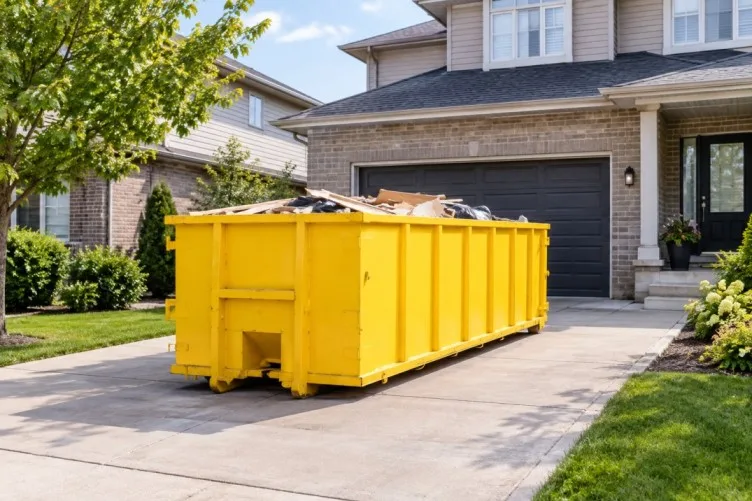
This single distinction decides almost everything. A bin parked on your driveway, in your yard, or anywhere else on private property is treated very differently than one placed on the street, boulevard, or any part of the public right-of-way.
2. How Toronto Regulates Bin Placement
The City of Toronto governs the use of public streets and sidewalks under its Municipal Code, and this is the framework that determines when a container placed outside your property line needs sign-off from the city.
Municipal Code Chapter 743, Streets and Sidewalks
Chapter 743 of the Toronto Municipal Code covers temporary street occupations, which is the category a bin placed on a public boulevard or roadway typically falls under. It sets out the process for requesting permission to occupy part of a public street temporarily.
3. When Driveway Placement Means No Permit Needed
If your driveway, front yard, or side yard can accommodate the bin, you generally won’t need to involve the city at all. This is the most common setup for the home cleanouts and renovation projects we deliver to across the GTA.
What Counts as “Private Property”
This includes your driveway, garage apron, backyard, or any part of the lot that belongs to you, as opposed to the boulevard strip (often the grassy or paved area between the sidewalk and the curb) which is typically still considered part of the public right-of-way even though it sits in front of your house.
4. When You’ll Need a Street Occupation Permit
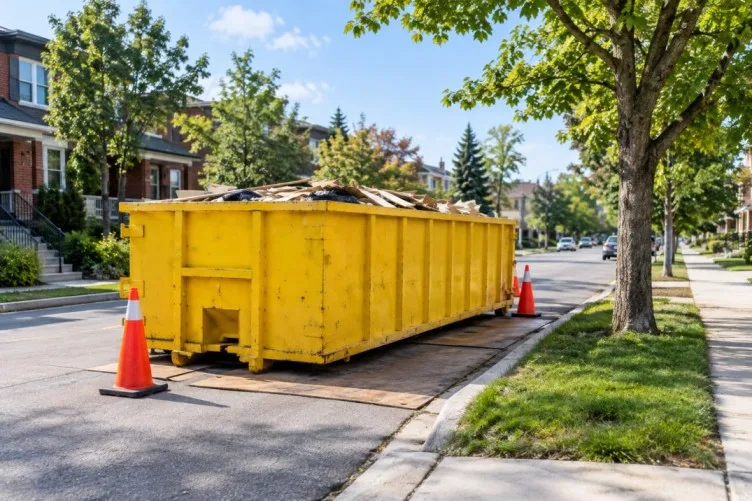
If there’s genuinely no room on the property, and the bin has to sit on the street or boulevard, that’s when a permit becomes necessary. This comes up most often on tight construction and job sites with limited on-property space.
Boulevards, Curbs, and Public Right-of-Way
Any space between your property line and the actual road, including the boulevard and curb area, falls under municipal jurisdiction. Placing a bin there without authorization can result in the city requiring its removal.
5. How Permit Rules Differ Across the GTA
Toronto’s Chapter 743 only applies within the City of Toronto’s boundaries. Every surrounding municipality in our service area sets its own rules for what happens on its streets, so the same driveway-versus-street principle applies everywhere, but the specific permit process, fees, and department you’d apply through will differ by city.
Toronto vs Surrounding Municipalities
Because we operate across nine service areas, we’re used to navigating a patchwork of local rules rather than one single bylaw, and we factor this into how we plan each delivery.
6. Mississauga and Peel Region Considerations
Mississauga, along with Brampton and Caledon, falls under Peel Region for many services, though municipal right-of-way rules are typically handled at the city level.
Checking with Peel Region Municipalities
If a driveway placement isn’t possible for a Mississauga project, we’d recommend confirming directly with the City of Mississauga’s local bylaw or roads department before street placement, since requirements can change and are best confirmed at the time of booking.
7. Vaughan, Markham, and Richmond Hill (York Region)
These three service areas, Vaughan, Markham, and Richmond Hill, fall under York Region, and each city manages its own road occupation permits independently.
York Region General Practice
As with Toronto, driveway placement in Vaughan, Markham, or Richmond Hill generally avoids the need for any permit. Street placement is the trigger point, and each city’s public works or roads department is the right place to confirm current requirements.
8. Brampton, Bolton, and Caledon
Brampton is its own municipality, while Bolton is a community within the Town of Caledon. Both maintain their own road use bylaws separate from Toronto’s.
Confirming Local Requirements
For projects in these areas, we default to driveway placement wherever possible for exactly this reason. It sidesteps the need to coordinate with a separate municipal department altogether.
9. Etobicoke and North York (Toronto Boroughs)
Unlike Mississauga, Brampton, or Vaughan, Etobicoke and North York are both part of the City of Toronto itself, having been amalgamated into the city in 1998.
Same Rules as Downtown Toronto
This means bin placements in Etobicoke and North York fall under the same Chapter 743 rules that apply anywhere else in Toronto proper, rather than a separate municipal bylaw.
10. What Information You’ll Need to Apply for a Permit
If street placement is unavoidable, the application process generally asks for a consistent set of details regardless of which municipality you’re dealing with.
Typical Application Details
Expect to provide the exact location of placement, the size of the bin, how long it will remain in place, and contact information for whoever is responsible for it. Having this ready before you call your local roads department speeds things up considerably. Our team can also help clarify these details when you request a quote.
11. How Long Does a Street Placement Permit Last?
Street occupation permits are almost always temporary by design, not an open-ended arrangement.
Typical Permit Durations
Duration varies by municipality and by the specifics of the project, so it’s worth confirming the exact window when you apply rather than assuming it will automatically cover your full rental period.
12. What Happens If You Skip the Permit?
Placing a bin on a public street without the required authorization isn’t just a formality you can skip, it can result in enforcement action.
Fines and Removal Risk
Municipalities can require the container to be removed, and in some cases issue fines to the property owner or the company responsible for the bin. This is part of why we ask about driveway access before every delivery, it’s simply the more straightforward option whenever it’s available.
13. Safety Requirements for Street-Placed Bins
Even with a valid permit, bins placed on a street or boulevard usually need to meet specific safety standards.
Reflectors, Barricades, and Visibility
This commonly includes visible markings identifying the bin owner, reflective material for nighttime visibility, and placement that doesn’t obstruct pedestrian or vehicle sightlines. These requirements exist to keep the street safe for everyone, not just to satisfy a checklist.
14. How to Avoid Needing a Permit Altogether
If avoiding the permit process entirely is the priority, there’s a straightforward way to do it.
Choosing Driveway Placement
Simply confirming your driveway or yard has enough clearance for delivery is usually all it takes. Our team can walk through this with you before booking if you’re unsure whether your space will work, whether it’s for a residential, commercial, or construction project.
15. Why We Default to Driveway Placement
Given the choice, we recommend driveway or private-property placement for nearly every job we deliver to.
Our Process for Planning Delivery
Before delivery day, we ask about your property layout so we can plan a placement that avoids the permit process altogether wherever possible. If a driveway genuinely isn’t an option, we’ll walk you through what street placement in your specific municipality would involve. You can read more about how our junk bin rental process works from booking to pickup.
16. Getting Your Bin Rental Started the Right Way
Understanding whether you need a permit shouldn’t be something you figure out after the bin has already arrived.
Book with Confidence
When you get a quote or call us at (416) 702-2467, mention your property layout and we’ll help you figure out the simplest placement option for your address, whether that’s in Toronto, Mississauga, Brampton, Vaughan, Markham, Richmond Hill, Caledon, Bolton, Etobicoke, or North York, before your bin rental is even delivered.
Frequently Asked Questions
Do I need a permit if the bin is on my driveway?
Generally no. Permits typically apply when a bin is placed on the street, boulevard, or other public right-of-way, not on private property like a driveway, yard, or garage apron.
What’s the fastest way to avoid the permit process entirely?
Confirm your driveway or yard has enough clearance for delivery. This is the single biggest factor in whether a permit is needed at all, and our team can help you check this before booking.
Do Etobicoke and North York follow different rules than downtown Toronto?
No. Since both are part of the City of Toronto, they fall under the same Municipal Code Chapter 743 rules as the rest of the city.
Does the same permit apply everywhere in the GTA?
No. Toronto’s Chapter 743 only applies within Toronto’s boundaries. Mississauga, Brampton, Vaughan, Markham, Richmond Hill, and Caledon each have their own separate bylaws and permit processes for street placement.
What happens if a bin is placed on the street without a permit?
The municipality can require the bin to be removed, and in some cases issue fines to the property owner or the company responsible for the container.
Can Rent A Bin help me figure out if I need a permit?
Yes. When you request a quote, let us know your property layout and we’ll help you plan a placement that avoids the permit process wherever possible, or walk you through what’s needed if street placement is unavoidable.